Global Oil Prices Jump 25% in Eight Days, Crossing $119 per Barrel as Iran War Escalates
Global oil prices surged past $119 per barrel following escalating geopolitical tensions in the Middle East, supply cuts from major oil-producing countries, and disruptions near the Strait of Hormuz. The sharp rise in crude prices has triggered volatility in global markets and raised concerns about prolonged fuel price increases and energy supply instability.
 admin
admin
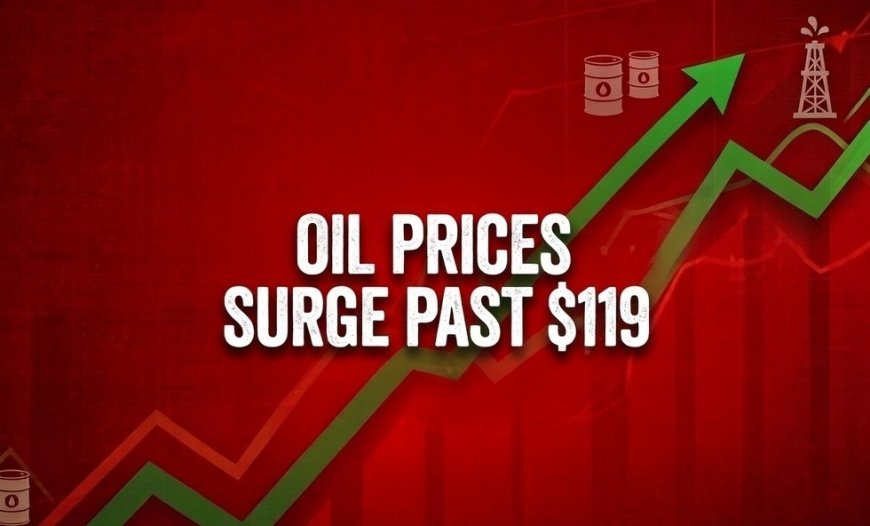
Oil Prices Surge Past $119 per Barrel Amid Supply Cuts and Rising Geopolitical Tensions
Global oil markets experienced a dramatic surge on Monday as crude prices climbed above $119 per barrel, marking one of the most significant single-day increases in recent years. The sharp rise followed escalating geopolitical tensions in the Middle East, supply reductions from key oil-producing countries, and growing concerns about disruptions to critical shipping routes.
The sudden spike pushed international benchmark Brent crude and West Texas Intermediate (WTI) to their highest levels since mid-2022, sparking renewed anxiety among investors, governments, and businesses that rely heavily on stable energy supplies.
Oil Markets React to Escalating Conflict
In early trading on Monday, Brent crude futures surged as much as 29 percent, reaching approximately $119.50 per barrel. At the same time, WTI crude, the primary benchmark for U.S. oil, climbed over 31 percent, briefly touching $119.48 per barrel.
These dramatic gains followed an already volatile week in the energy markets. Brent crude had previously risen by roughly 27 percent, while WTI recorded an even larger increase of more than 35 percent during the previous trading sessions.
However, as markets began to stabilize later in the day, some of those gains were reduced. By late morning in Middle Eastern trading hours, Brent crude was trading around $105.80 per barrel, still representing a strong daily increase of over 14 percent. Meanwhile, WTI settled near $100.80, reflecting a rise of nearly 11 percent for the session.
Despite the slight pullback, analysts say the market remains extremely volatile, driven by fears that the ongoing conflict in the Middle East could severely disrupt global energy supply chains.
Strategic Importance of the Strait of Hormuz
One of the biggest concerns affecting oil markets is the situation surrounding the Strait of Hormuz, a narrow but vital waterway connecting the Persian Gulf to global shipping routes.
Roughly 20 percent of the world’s oil supply passes through this strategic channel each day, making it one of the most critical chokepoints in the global energy system.
Shipping companies have already begun to limit tanker movements through the region due to rising security risks and the possibility of military confrontations. As a result, the slowdown in oil transport is placing additional pressure on global supplies.
Asian economies, which depend heavily on crude imports from the Middle East, are particularly vulnerable to prolonged disruptions in this region.
According to Vasu Menon, managing director for investment strategy at OCBC Bank, the outlook for oil prices largely depends on how quickly shipping operations resume.
He warned that if oil flows through the Strait of Hormuz remain restricted and regional tensions continue to escalate, the upward pressure on prices could persist for an extended period.
Supply Cuts from Major Oil Producers
Adding to the market’s anxiety are recent production cuts by several key energy producers in the region. Countries such as Iraq and Kuwait have reportedly begun reducing oil output as export operations face logistical challenges linked to the conflict.
In parallel, Qatar had already reduced shipments of liquefied natural gas due to disruptions affecting regional transport infrastructure.
Industry analysts now believe that additional supply reductions may occur if storage facilities in major producing countries reach capacity. Some experts have suggested that Saudi Arabia and the United Arab Emirates could soon face similar constraints if export routes remain compromised.
One industry source indicated that oil production from Iraq’s main southern oilfields has dropped dramatically. Output reportedly declined by approximately 70 percent, falling to around 1.3 million barrels per day due to the country’s inability to ship crude through regional export channels.
Meanwhile, officials from the state-run Basra Oil Company stated that crude storage facilities have nearly reached maximum capacity, limiting the ability to continue pumping oil at normal levels.
Rising Security Threats to Energy Infrastructure
Security concerns have also intensified across the region as energy infrastructure becomes increasingly vulnerable to military incidents.
In the Fujairah industrial zone, a fire reportedly broke out after debris fell within the oil storage area. Authorities confirmed that the incident caused no injuries but highlighted the potential risks facing energy facilities.
Meanwhile, Saudi defense officials said a drone heading toward the Shaybah Oil Field was successfully intercepted before reaching its target.
These developments have further heightened market anxiety, as any successful strike on major oil facilities could trigger even larger disruptions to global supply.
Political Developments Add to Market Uncertainty
Political changes in the region have also contributed to market volatility. The appointment of Mojtaba Khamenei as Iran’s new supreme leader following the death of his father, Ali Khamenei, has signaled continuity in the country’s political leadership during a period of heightened conflict.
Some analysts believe this leadership transition could complicate international efforts to reduce tensions in the region.
Commodity strategist Satoru Yoshida of Rakuten Securities noted that the leadership change may strengthen hardline political positions within Iran, potentially prolonging geopolitical disputes affecting oil supply routes.
Yoshida suggested that crude prices could rise even further if tensions escalate, predicting that WTI could climb to $120 or even $130 per barrel in the near future if supply disruptions continue.
Global Financial Markets React
The surge in oil prices has already triggered sharp reactions in global financial markets. In Asia, the benchmark Nikkei 225 dropped as much as 7 percent during early trading on Monday, reflecting investor concerns about the economic impact of higher energy costs.
Other Asian stock markets also experienced declines as traders reassessed the potential consequences of prolonged energy price volatility.
Higher oil prices tend to increase transportation costs, raise manufacturing expenses, and put pressure on consumer prices, potentially contributing to inflation across global economies.
Potential for Prolonged Fuel Price Increases
Energy experts warn that the consequences of the current crisis could last far beyond the immediate conflict.
Even if hostilities were to subside quickly, the damage to infrastructure, logistical disruptions, and heightened security risks could take weeks or even months to resolve.
Daniel Hynes, a senior commodity strategist at ANZ Bank, said the next major concern would be whether oil producers are forced to shut down wells entirely.
If that were to occur, restarting production could take significant time even after the conflict ends, potentially keeping oil prices elevated for an extended period.
Calls for Emergency Energy Measures
In response to the rapid rise in energy prices, some political leaders in the United States have called for emergency measures to stabilize the market.
Chuck Schumer, leader of the Senate Democratic caucus, urged Donald Trump to release oil from the Strategic Petroleum Reserve.
Such a move, he argued, could help ease supply pressures and reduce the price shock affecting consumers.
Releasing oil from emergency reserves has historically been used by governments to stabilize markets during periods of severe supply disruptions.
Mining Sector Developments in Saudi Arabia
While global markets focused on oil prices, Saudi Arabia also announced new developments in its mining industry as part of broader efforts to diversify its economy.
The Saudi Ministry of Industry and Mineral Resources confirmed that 29 new mining licenses were issued in January 2026.
According to ministry spokesperson Jarrah Al-Jarrah, the licenses included 21 quarry permits for building materials, seven exploration licenses, and one permit for a small mining operation.
By the end of January, the total number of active mining licenses in the kingdom reached 2,934.
Among these:
-
1,565 licenses were issued for quarrying building materials
-
1,016 licenses covered mineral discovery
-
276 licenses were designated for mining exploitation and small mines
-
68 licenses were granted for exploration activities
-
Nine licenses were issued for surplus mineral resources
These developments reflect Saudi Arabia’s ongoing strategy to expand its mining sector and reduce reliance on oil revenues by promoting investment in natural resources.
A Volatile Outlook for Energy Markets
With geopolitical tensions still unfolding and energy infrastructure facing increasing risks, the global oil market is likely to remain highly volatile in the coming weeks.
Much will depend on the stability of shipping routes, particularly through the Strait of Hormuz, as well as the ability of major oil-producing nations to maintain production and export levels.
For consumers, businesses, and governments around the world, the sudden surge in oil prices serves as a reminder of how deeply interconnected energy markets are with geopolitical developments—and how quickly global supply chains can be disrupted.