Atiku Meets Kwankwaso in Kano, Signals Strong ADC Alliance Ahead of 2027
Former Vice-President Atiku Abubakar met with Rabiu Kwankwaso in Kano to strengthen unity within the African Democratic Congress (ADC), discussing party progress, national development, and strategic positioning ahead of the 2027 elections.
 admin
admin
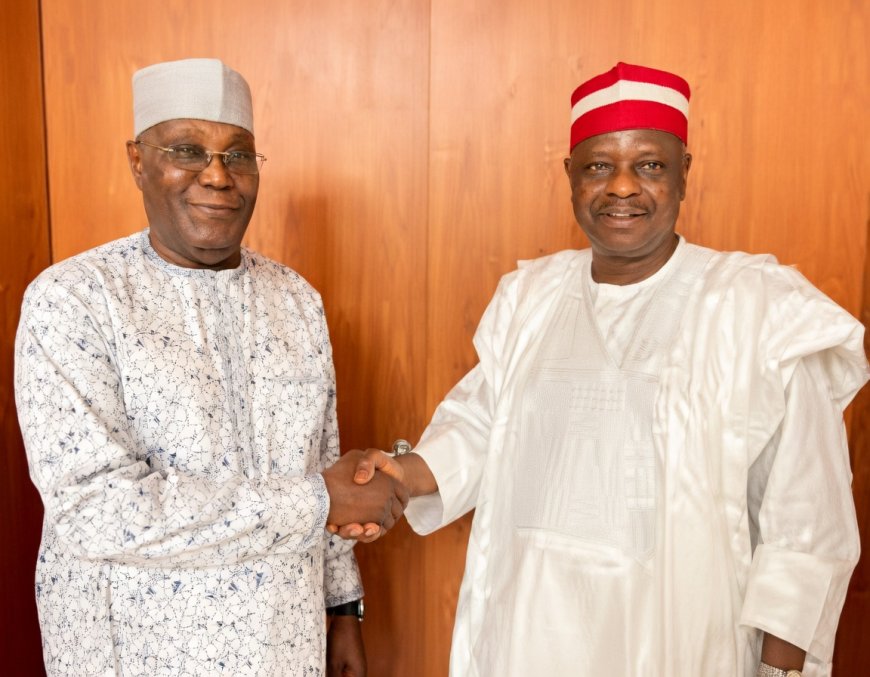
Former Vice-President Atiku Abubakar on Wednesday held a high-level political meeting with Rabiu Kwankwaso at the latter’s residence in Kano, in what observers have described as a significant step toward strengthening internal cohesion within the African Democratic Congress (ADC). The engagement, which took place in a cordial atmosphere, underscored ongoing efforts by key stakeholders to reposition the party ahead of future electoral contests and reinforce its commitment to national development.
In a statement released via his verified social media platform, Abubakar described the visit as both strategic and symbolic, emphasizing the importance of sustained dialogue among party leaders. According to him, the meeting provided an opportunity to deliberate extensively on the current trajectory of the ADC, as well as to evaluate its readiness to address pressing governance challenges confronting Nigeria. He noted that the discussions were not only forward-looking but also rooted in a shared vision of political inclusiveness, institutional stability, and socio-economic recovery.
The former vice-president further highlighted the need for unity within the party, stressing that political collaboration remains essential to achieving meaningful reforms. He reiterated that the ADC must continue to build consensus among its members while strengthening its grassroots structures across the country. In his remarks during the visit, Abubakar conveyed a message of solidarity on behalf of the party’s leadership and broader membership, formally welcoming Kwankwaso into the ADC fold and affirming collective dedication to the party’s objectives.
Addressing his host, Abubakar remarked that the time had come for like-minded political actors to consolidate their efforts toward restoring good governance, enhancing national security, and promoting equitable development. He argued that Nigeria’s current socio-political landscape demands pragmatic leadership and a renewed commitment to policies capable of delivering tangible benefits to citizens. His comments reflected a broader narrative within the ADC, which positions itself as a platform for reform-oriented governance and national renewal.
In his response, Kwankwaso expressed appreciation for the visit, describing it as a demonstration of mutual respect and shared political purpose. He affirmed his decision to align with the ADC, noting that both he and his supporters are committed to working collaboratively with party leaders at all levels. According to him, the party has already shown encouraging signs of unity and coordination, particularly at the national level, which he believes will serve as a strong foundation for future success.
Kwankwaso also conveyed optimism regarding the ADC’s electoral prospects, suggesting that the party possesses the capacity to expand its influence beyond its traditional strongholds. He emphasized that sustained cooperation among members, coupled with strategic engagement across regions, could position the ADC as a formidable contender in upcoming elections. His remarks pointed to a broader ambition of achieving nationwide relevance, with particular emphasis on strengthening the party’s presence in both northern and southern Nigeria.
The meeting follows Kwankwaso’s recent formal entry into the ADC, an event that took place earlier in the week at the well-known Kwankwasiyya political headquarters in Kano. During that ceremony, he completed his registration as a party member and was officially presented with his membership credentials, signaling the beginning of a new political chapter ahead of the 2027 general elections. The occasion attracted several prominent figures within Nigeria’s political landscape, reflecting the growing attention surrounding developments within the ADC.
Notable attendees at the event included David Mark, the party’s national chairman, as well as influential political actors such as Aminu Tambuwal, Rotimi Amaechi, Peter Obi, Dino Melaye, and John Odigie-Oyegun. Their presence highlighted the broader coalition-building efforts currently underway within the party, as it seeks to attract experienced leaders and consolidate its political base.
Kwankwaso’s transition to the ADC comes in the wake of his resignation from the New Nigerian Peoples Party (NNPP), the platform under which he previously contested the 2023 presidential election. In announcing his departure, he expressed gratitude to the NNPP for the opportunity to serve as its national leader and presidential candidate, while also indicating his readiness to embrace new political alliances in pursuit of broader national objectives.
Political analysts view these recent developments as indicative of a shifting landscape within Nigeria’s opposition politics, where realignments and strategic partnerships are becoming increasingly prominent. The engagement between Abubakar and Kwankwaso, in particular, is seen as a reflection of ongoing efforts to forge a unified front capable of addressing governance deficits and providing credible alternatives to existing political structures.
As Nigeria moves closer to the next electoral cycle, the emphasis on unity, policy coherence, and institutional strengthening within parties such as the ADC is expected to play a critical role in shaping voter perceptions. The outcome of these internal engagements may ultimately determine the party’s ability to translate its vision into electoral success, as well as its capacity to contribute meaningfully to the country’s democratic evolution.