Iran Strikes Pro-American Kurdish Forces in Northern Iraq
Iran has carried out missile and drone strikes on bases belonging to Iranian Kurdish opposition groups in northern Iraq, escalating cross-border tensions in the region. The attacks reportedly targeted facilities linked to the Democratic Party of Iranian Kurdistan and other Kurdish factions, resulting in casualties and significant damage. The strikes come amid growing speculation about the possible involvement of Kurdish fighters in the broader conflict involving Iran, the United States, and Israel, though Kurdish leaders deny any current military incursion into Iranian territory.
 admin
admin
Iran Intensifies Strikes on Kurdish Opposition Bases in Northern Iraq Amid Rising Regional Tensions
Iran’s military has launched a series of targeted strikes against bases belonging to Iranian Kurdish opposition groups located in northern Iraq, signaling an escalation in tensions between Iran and Kurdish factions operating across the border. The attacks, which reportedly involved missiles and drone strikes, come at a time of heightened geopolitical uncertainty in the Middle East, with ongoing military confrontations and speculation about potential regional alliances.
According to statements released by Iranian military authorities, the strikes were directed at what Tehran described as “Kurdish groups opposed to the Islamic revolution” that are based in the semi-autonomous Kurdish region of northern Iraq. Officials stated that three missiles were launched at positions believed to be used by these groups for coordination and training activities.
Casualties and Damage Reported
The attacks occurred over two consecutive days, Tuesday and Wednesday, resulting in casualties and structural damage at multiple locations. Local sources confirmed that at least one person was killed while several others were injured during the strikes.
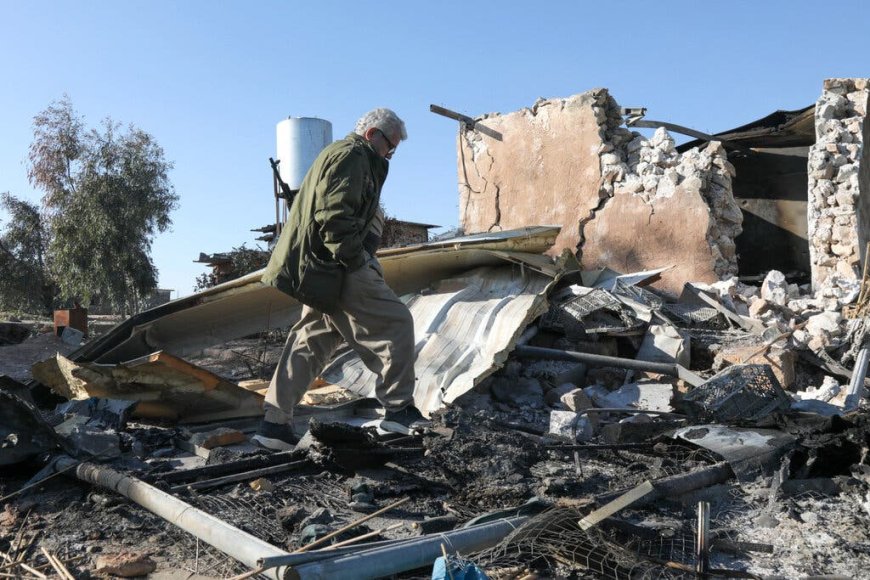
Reports gathered by journalists from the BBC indicate that four fighters affiliated with Kurdish opposition forces were wounded when a ballistic missile struck one of the compounds. One of the injured fighters later succumbed to his injuries, raising the death toll from the incident.
At the targeted site, significant destruction was visible. A large section of a building had collapsed following the missile impact, leaving debris, twisted metal, and shattered materials scattered across the surrounding area. Witnesses also reported seeing a deep crater in the ground, believed to have been created by the explosive force of the missile.
A separate facility belonging to the Democratic Party of Iranian Kurdistan (KDPI) was also reportedly struck earlier in the week. In that case, drones were used to carry out two separate strikes on Tuesday, causing injuries to at least one civilian who happened to be near the targeted location.
Kurdish Groups Deny Military Incursion into Iran
The attacks have occurred amid widespread speculation that Kurdish opposition forces based in Iraq might soon play a role in the broader conflict involving Iran and its regional adversaries. However, leaders of Iranian Kurdish political organizations have strongly rejected claims that their fighters have already crossed into Iranian territory.
Kurdistan Freedom Party (PAK) spokesperson Hanna Hussein Yazdan Pana dismissed such reports as inaccurate and misleading. She emphasized that none of the Kurdish fighters stationed in Iraq had initiated any movement toward Iran.
“This is simply not true,” she stated during an interview. “No Peshmerga fighter has crossed the border, and none of our forces act independently.”
Pana explained that several Iranian Kurdish opposition movements recently formed a coalition to coordinate political and strategic efforts. The coalition includes six separate groups that have been discussing potential future actions. Nevertheless, she noted that any significant move would depend heavily on external conditions and international support.
Calls for Air Protection and International Support
According to Pana, Kurdish forces would require substantial strategic backing before attempting operations inside Iran. She stressed that the absence of air protection would make any ground action extremely risky.
“We cannot advance unless the skies above us are secure,” she said. “If the Iranian military infrastructure—particularly weapons depots and air defense systems—is not neutralized, sending fighters across the border would be extremely dangerous.”
She also suggested that establishing a no-fly zone over certain areas could provide the necessary protection for Kurdish fighters. Without such measures, she argued, Kurdish groups would be unable to counter the advanced military capabilities of the Iranian armed forces.
“The regime is very brutal,” Pana added. “Our fighters are determined, but the most advanced weapon many of them possess is a Kalashnikov rifle.”
Speculation Over U.S. Strategy
The renewed violence comes as speculation grows about whether Donald Trump, the President of the United States, might consider supporting Kurdish opposition groups as part of broader strategic efforts against Iran.
Some reports have suggested that Washington could encourage Kurdish forces to become a ground presence in a potential conflict with Tehran. However, officials at the White House have publicly denied claims that the administration is currently planning to arm Kurdish fighters for such a role.
Despite the denial, discussions about the possible involvement of Kurdish forces have intensified among analysts and policymakers. The Kurdish population has historically played a complex role in regional conflicts due to its geographic distribution across several Middle Eastern countries.
Fighters Express Readiness for Potential Conflict
Within Kurdish opposition ranks, some fighters appear eager to participate in future efforts aimed at challenging Iran’s leadership. A 25-year-old KDPI fighter identified as Hassan described the current situation as a critical moment for Kurdish aspirations.
Armed with an AK-47 rifle, he said he would be willing to return to Iran if circumstances allowed.
“We believe we are closer than ever to achieving freedom,” Hassan said, expressing hope that Kurdish fighters might soon take part in efforts to challenge Iranian authority in Kurdish-majority regions.
Ethnic Diversity and Political Complexity in Iran
Experts note that Iran’s internal dynamics are shaped by significant ethnic diversity. According to Simon Gass, a former British ambassador to Tehran, the country is composed of multiple ethnic groups alongside the Persian majority.
Speaking on a programme of BBC Radio 4, Gass described Iran as “a patchwork of different ethnic communities,” including Kurds, Baloch, Arabs, and Azeris.
He suggested that if external actors were able to encourage armed uprisings among these minority groups, it could create additional challenges for Iran’s government.
“If such movements were supported by international forces capable of providing air support, the strategic landscape could change significantly,” he explained.
However, Gass also cautioned that Kurdish fighters are relatively lightly armed compared to Iran’s well-equipped military forces. Under normal circumstances, he said, Kurdish militias would face considerable difficulty confronting the Iranian army without outside assistance.
The Kurdish Population Across the Middle East
The Kurdish people represent one of the largest ethnic groups in the Middle East without an independent nation-state. More than 30 million Kurds live in a mountainous region that spans parts of Turkey, Iraq, Syria, Iran, and Armenia.
In Iran alone, Kurds make up roughly 10 percent of the country’s population of about 91 million. While Iran’s majority population follows Shia Islam, many Kurdish communities are predominantly Sunni Muslim and reside mainly in the north-western provinces bordering Iraq and Turkey.
Human rights organizations have frequently highlighted the challenges faced by Kurdish communities within Iran. The global advocacy group Amnesty International has previously reported that Iranian Kurds have experienced long-standing discrimination affecting various aspects of their lives.
According to the organization, Kurdish citizens in Iran have faced restrictions related to political participation, cultural expression, and economic opportunities. These concerns have contributed to ongoing tensions between Kurdish activists and Iranian authorities.
Regional Uncertainty Continues
The recent missile and drone strikes underscore the fragile security environment along the Iran-Iraq border. As military operations continue and diplomatic tensions persist, observers warn that the involvement of additional actors could further complicate the situation.
For now, Kurdish groups appear cautious about escalating their activities, emphasizing the need for strategic coordination and international backing before any significant military move. Meanwhile, Iran’s continued strikes against opposition positions suggest that the confrontation between Tehran and Kurdish factions remains far from over.