Oil prices rise sharply as Middle East Conflict Escalates
Global oil prices surged sharply as escalating military tensions between the United States, Israel, and Iran threatened to disrupt energy supplies through the Strait of Hormuz. Brent crude and West Texas Intermediate recorded significant gains, while global stock markets declined amid fears of prolonged conflict, inflationary pressure, and supply chain instability. OPEC+ announced a production increase in response, but uncertainty continues to weigh heavily on financial markets worldwide.
 admin
admin
Global Oil Markets Jolt as Middle East Conflict Escalates
A sharp escalation in hostilities between the United States, Israel, and Iran has sent shockwaves through global financial markets, triggering a surge in crude oil prices and a broad retreat in equities. The renewed instability in the Middle East—an epicenter of global energy production—has heightened fears of supply disruptions, prompting traders to reassess risk exposure across commodities, currencies, and stock markets worldwide.
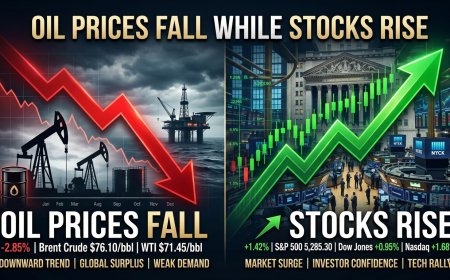
Early Monday trading reflected the scale of investor concern. West Texas Intermediate (WTI) crude, the benchmark for U.S. oil, climbed steeply to $72.79 per barrel, marking an increase of roughly 8.6 percent from its Friday close near $67, according to data released by the CME Group. Meanwhile, Brent crude, the leading international oil benchmark, advanced to $79.41 per barrel in early trading, up 9 percent from $72.87 at the end of last week, based on figures compiled by FactSet. The jump pushed Brent to its highest level in seven months, underscoring the intensity of the market’s reaction.
Escalating Conflict Fuels Supply Fears
The rise in energy prices follows reports of sustained military strikes by U.S. and Israeli forces on Iranian targets, coupled with retaliatory missile attacks by Iran on Israeli and American military installations across the region. Statements from U.S. President Donald Trump suggesting that operations would persist until strategic objectives are achieved have further dampened hopes for swift de-escalation.
Market participants are particularly sensitive to the risk of a broader regional spillover. Iran’s countermeasures, including missile launches across multiple fronts, have raised the possibility that neighboring states could be drawn into the confrontation. Such a development would threaten not only regional stability but also the uninterrupted flow of energy exports from some of the world’s largest oil producers.
Strategic Chokepoint: The Strait of Hormuz
At the center of global concern lies the Strait of Hormuz, a narrow maritime passage connecting the Persian Gulf to the Arabian Sea. Roughly one-fifth of the world’s seaborne oil trade transits this critical corridor. Tankers navigating the strait transport crude and liquefied natural gas from Saudi Arabia, Kuwait, Iraq, Qatar, Bahrain, the United Arab Emirates, and Iran to international markets.
Although the waterway has not been formally closed, shipping data indicates that tanker traffic has slowed considerably. Some vessels have reportedly paused near the entrance to the strait amid security concerns, while others face difficulty obtaining insurance coverage for passage through the high-risk zone. Reports of two vessels being attacked over the weekend have amplified anxieties within maritime and energy circles.
Jorge Leon, head of geopolitical analysis at the consultancy Rystad Energy, noted that any effective suspension of transit through the strait could block up to 15 million barrels of crude oil per day from reaching global markets. He cautioned that absent clear signals of diplomatic de-escalation, oil prices may undergo further upward repricing.
Inflationary Pressures Resurface
Higher crude prices inevitably filter down to consumers. Rising energy costs translate into more expensive gasoline at retail pumps and increased transportation and production expenses across supply chains. At a time when households in many economies continue to grapple with lingering inflationary pressures, a sustained oil shock could compound economic strain.
The memory of recent disruptions remains fresh. In mid-February, Iran temporarily restricted sections of the Strait of Hormuz during a military exercise, prompting oil prices to rise approximately 6 percent in the subsequent days. The current standoff, however, carries more severe geopolitical implications and therefore poses a greater risk to sustained energy flows.
OPEC+ Moves to Stabilize Supply
Against this volatile backdrop, members of the OPEC+ alliance have sought to reassure markets. Eight participating countries announced plans to increase collective production beginning in April. The Organization of the Petroleum Exporting Countries had scheduled the meeting prior to the outbreak of hostilities, but its decision to raise output by 206,000 barrels per day exceeded analyst expectations.
The countries participating in the production boost include Saudi Arabia, Russia, Iraq, the United Arab Emirates, Kuwait, Kazakhstan, Algeria, and Oman. While the incremental supply may help cushion immediate price spikes, analysts caution that even coordinated output increases may struggle to offset a prolonged disruption in the Strait of Hormuz.
Equity Markets React Cautiously
Stock markets across Asia, Europe, and North America reflected investor unease. In Japan, the Nikkei 225 fell 1.3 percent as the country—entirely dependent on imported oil—faces heightened vulnerability to energy price volatility. In China, blue-chip shares experienced a more modest decline of 0.1 percent, while the broader Asia-Pacific index excluding Japan dropped 1.2 percent.
European futures also signaled weakness. Contracts tied to the EURO STOXX 50 fell 1.3 percent, while Germany’s DAX futures slid 1.4 percent. In London, FTSE futures declined 0.6 percent. On Wall Street, futures for both the S&P 500 and Nasdaq registered losses of approximately 0.8 percent in early trading, suggesting that American equities may open lower amid mounting geopolitical risk.
In the Middle East, precautionary measures extended to capital markets. Authorities in the United Arab Emirates and Kuwait temporarily suspended trading on their stock exchanges, citing exceptional circumstances and the need to maintain orderly market operations.
Currency Markets and Safe-Haven Flows
The ripple effects of the oil surge extended into foreign exchange markets. The U.S. dollar strengthened as investors gravitated toward perceived safe-haven assets. The United States’ status as a net energy exporter offers partial insulation from global supply shocks, enhancing the dollar’s appeal during periods of turbulence. U.S. Treasury bonds, traditionally viewed as liquid and secure investments, also attracted renewed interest.
Consequently, the euro slipped 0.2 percent to $1.1787, reflecting relative currency weakness against the dollar amid heightened uncertainty.
China’s Strategic Position
Iran exports approximately 1.6 million barrels of oil per day, with China accounting for the bulk of its purchases. Any sustained interruption to Iranian shipments would require Beijing to diversify its sourcing. Analysts suggest that China maintains substantial strategic petroleum reserves and retains the flexibility to increase imports from Russia and other suppliers, potentially mitigating the impact of Iranian shortfalls.
Nonetheless, broader global demand dynamics mean that even localized supply adjustments can reverberate across pricing structures worldwide.
Outlook: Volatility Ahead
The trajectory of oil markets in the coming weeks will hinge largely on geopolitical developments. A swift diplomatic breakthrough could ease supply fears and stabilize prices. Conversely, prolonged confrontation or an outright closure of the Strait of Hormuz would likely intensify volatility, pushing energy costs—and by extension global inflation—higher.
For now, traders remain on edge. With energy supply chains deeply interconnected and global economic growth already navigating fragile terrain, the unfolding Middle East crisis has reintroduced a familiar but formidable variable into the calculus of international markets: geopolitical risk.