Iran Drone Strikes Target Dubai: Burj Al Arab and International Airport Damaged
Overnight drone strikes from Iran hit Dubai, causing minor damage to the Burj Al Arab, Dubai International Airport, and Jebel Ali Port, injuring several and disrupting flights across the Middle East.
 admin
admin
Widespread Attacks Across the United Arab Emirates Mark Dangerous Escalation in Regional Conflict
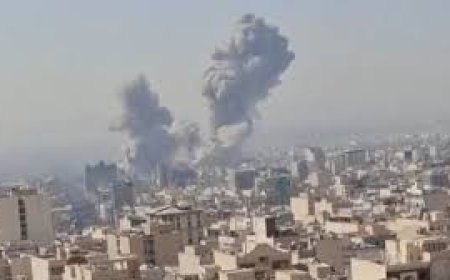
In a dramatic escalation of hostilities that sent shockwaves through the Persian Gulf region, Iranian retaliatory strikes overnight caused significant disruption to the United Arab Emirates' most prominent civilian and commercial infrastructure, including damage to Dubai International Airport—the world's busiest travel hub—and the iconic Burj Al Arab hotel . The attacks, which spread across multiple Gulf states, marked a dangerous widening of the conflict between Iran and US-Israeli forces, reaching far beyond American military installations to strike at the heart of the region's economic powerhouse .
Casualties and Damage at Critical Infrastructure
Four airport personnel sustained injuries when a concourse at Dubai International Airport (DXB) was hit during the barrage, according to an official statement from the emirate's media office released early Sunday . The Dubai Media Office confirmed on X that "a concourse at Dubai International (DXB) sustained minor damage in an incident, which was quickly contained," though authorities declined to provide specific details about the nature of the attack .
"Emergency response teams were immediately deployed and are managing the situation in coordination with the relevant authorities," the statement added, noting that due to comprehensive contingency plans already in place, most terminals had been cleared of passengers before the strike occurred . The four injured staff members received prompt medical attention at the scene .
The damage to Dubai International Airport represents a significant blow to a facility that serves as the primary aviation gateway between East and West. Dubai International is consistently ranked among the world's busiest airports for international passenger traffic, handling approximately 90,000 passengers daily under normal circumstances . The airport and seaport operations collectively account for an estimated 60 percent of the emirate's revenues, according to official estimates, underscoring the economic implications of the attack .
Symbolic Strike on Dubai's Most Recognizable Landmark
In a development laden with symbolic weight, authorities confirmed that the Burj Al Arab—the sail-shaped luxury hotel that has become synonymous with Dubai's global image of opulence and architectural ambition—suffered damage during the attacks . The Dubai Media Office reported that air defense systems successfully intercepted a drone, but falling debris caused a minor fire on the hotel's outer facade .
"Authorities confirm that a drone was intercepted and debris caused a minor fire on the Burj Al Arab's outer facade," the Dubai Media Office wrote on X. "Civil Defence teams responded immediately and brought the incident under control. No injuries have been reported" .
The Burj Al Arab, which opened in December 1999 on an artificial island off Jumeirah Beach, has long stood as the emirate's most recognizable symbol . The 60-story tower, sometimes marketed as the world's first "seven-star" hotel, was designed to project Dubai's ambitions on a global scale, transforming a former desert outpost into a luxury destination capable of attracting the world's elite . The fact that Iranian strikes reached this carefully cultivated symbol of Gulf prosperity sent an unmistakable message about the vulnerability of even the most protected assets in the region .
Witnesses near the hotel reported hearing explosions and seeing smoke rising from the iconic structure, though authorities moved quickly to contain both the damage and any potential panic . The quick response of Civil Defence teams prevented what might have become a catastrophic fire at the highly flammable structure .
Palm Jumeirah and Jebel Ali Port Also Targeted
The attacks were not limited to the city's most famous landmarks. Dubai's artificial Palm Jumeirah island—a palm-tree-shaped residential and leisure development visible from space—also came under fire . Two witnesses on the island reported hearing an explosion and observing smoke rising from the Fairmont The Palm hotel, a five-star property that caters to wealthy tourists and residents .
Video footage circulating on social media showed flames engulfing portions of the hotel, with fire apparently spreading across multiple floors of the grand structure while thick black smoke billowed into the night sky . The Dubai Media Office subsequently confirmed an "incident" in a building on the Palm Jumeirah caused a fire and injured four people .
Additionally, one of the berths at Dubai's Jebel Ali Port—the Middle East's largest seaport and a facility capable of hosting US Navy aircraft carriers—caught fire due to debris resulting from an aerial interception . The Dubai Media Office issued a separate statement confirming that "Dubai Civil Defence teams responded immediately and are continuing their efforts to fully extinguish the fire" at the critical maritime facility . Jebel Ali Port serves as a vital hub for global shipping lanes and hosts US warships as part of America's strategic military presence in the Gulf .
Regional Scope: Attacks Across the Gulf Cooperation Council
The Iranian retaliatory operation extended well beyond Dubai's borders, striking targets across multiple Gulf states in what appeared to be a coordinated response to earlier US and Israeli military actions . According to the UAE Defence Ministry, Iran fired a staggering 137 missiles and 209 drones at Emirati territory, with most projectiles intercepted by the country's air defense systems .
In a particularly tragic incident at Abu Dhabi's Zayed International Airport, officials confirmed that at least one person was killed and seven others wounded . The deceased was identified as a Pakistani civilian struck by falling debris during the attack . Abu Dhabi Airports initially posted confirmation of the casualties on X but later deleted the statement without explanation, raising questions about information control in the wake of the strikes .
"The UAE defence ministry said most of the missiles and drones were intercepted but at Abu Dhabi's Zayed International Airport officials said at least one person was killed and seven wounded in an 'incident,'" reported international news agencies covering the aftermath .
Bahrain also suffered significant damage, with authorities there confirming that Bahrain International Airport was directly targeted . "Bahrain International Airport was targeted by a drone, resulting in material damage but no loss of life, while the relevant authorities are taking measures to secure the site," the interior ministry posted on X early Sunday . Bahrain is home to the US Navy's Fifth Fleet, making it a particularly high-value target in the Iranian retaliation .
In Qatar, officials reported that Iran launched 65 missiles and 12 drones toward the gas-rich Gulf state . While most were intercepted, eight people sustained injuries in the salvos, with one victim listed in critical condition . The attacks specifically targeted Qatar's Al Udeid air base, the region's largest US military installation and a crucial command hub for American operations in the Middle East .
Kuwait also came under fire, with a drone striking Kuwait International Airport and targeting a base housing American personnel . Three Kuwaiti soldiers and 12 other individuals were wounded in the attacks, according to local authorities . Italian Foreign Minister Antonio Tajani reported that an Iranian missile caused "significant damage" to the runway at an air base hosting Italian air force personnel in Kuwait .
Aviation Chaos and Stranded Passengers
The coordinated attacks triggered immediate and widespread disruption to civil aviation across the region . Flight-tracking maps showed airspace over much of the Middle East virtually empty as airlines suspended operations indefinitely . Major carriers including Emirates, Qatar Airways, and Etihad Airways—which collectively move approximately 90,000 passengers through Gulf hubs daily—halted flights to and from Dubai, Abu Dhabi, and Doha .
Dubai Airports took the extraordinary step of suspending all operations at both Dubai International and Al Maktoum International at Dubai World Central, urging passengers not to travel to the facilities . The closures left hundreds of thousands of travelers stranded or forced to seek alternative routes, with more than 1,000 flights canceled across the region .
Among those caught in the chaos was Indian badminton star PV Sindhu, who found herself stranded at Dubai International Airport for over eight hours while en route to Birmingham for the All England Championships . Sindhu shared a video on Instagram showing passengers waiting amid uncertainty, with a stark message indicating all flights had been suspended until further notice . Her predicament highlighted the far-reaching consequences of the conflict for ordinary travelers and international commerce .
"One Asian national was killed and seven others were injured at Abu Dhabi airport, while four injuries were reported at Dubai airport," News18 reported, citing official sources . Videos circulating on social media showed panicked passengers running along concourses as smoke spread through terminals, while water triggered by fire suppression systems collected on floors .
Regional Reactions and Geopolitical Implications
The unprecedented barrage across multiple wealthy Gulf monarchies sent shockwaves through a region that has long traded on its reputation for stability and security . The attacks targeted not only military installations but also civilian infrastructure and residential areas, raising fears of a wider conflict that could engulf the entire Gulf .
"We are scared of what the future is for us now, and we can't say how the next few days are going to be," Maha Manbaz, a nursing student in Doha, told international media . Her sentiment was echoed by residents across the region, many of whom are expatriates who chose to live in the Gulf precisely because of its perceived safety compared to other parts of the Middle East .
"The sound of the first explosion terrified me," said a 50-year-old retiree living near the US base in Manama's Juffair area, where residents were quickly evacuated from their homes . A Lebanese woman residing in Riyadh expressed similar shock: "We came to the Gulf because it's known to be safer than Lebanon. Now I don't know what to do or how to think really" .
The attacks came in response to joint US-Israeli military actions against Iranian targets, which Tehran characterized as aggression requiring a firm response . The United States Central Command (CENTCOM) sought to downplay damage to American assets, posting on X that no US naval vessels were hit, damage to US facilities was minimal, and no American casualties had been reported .
However, the strikes clearly succeeded in penetrating the region's much-vaunted air defense systems and reaching critical infrastructure, raising uncomfortable questions about the vulnerability of Gulf states to Iranian retaliation . The fact that every Gulf state except Oman—which has served as a mediator in US-Iran talks—was hit by the barrage underscored the comprehensive nature of the Iranian response .
"The Gulf states are sandwiched between Iran and Israel, and have to bear the worst inclinations of both," observed Bader al-Saif, an assistant professor at Kuwait University . "Iran's attacks on the Gulf are misplaced. They'll only alienate its neighbours and invite further distancing from Iran" .
Diplomatic Fallout and Future Uncertainties
The attacks prompted immediate diplomatic responses from affected nations, with the UAE, Saudi Arabia, and Qatar warning that they reserved the right to respond . Saudi Arabia's de facto ruler, Crown Prince Mohammed bin Salman, placed a call to UAE President Mohamed bin Zayed—their first conversation since a public disagreement in late December—to discuss the Iranian strikes and express solidarity .
The United Nations Security Council convened an emergency session to address the rapidly deteriorating situation . UN Secretary-General António Guterres issued an urgent appeal for all parties to immediately cease hostilities . China's permanent representative to the UN, Fu Cong, expressed dismay at the timing of the escalation, noting that "the relevant military strikes occurred at a time when the US and Iran were in the midst of diplomatic negotiations, which is shocking" .
As Gulf states moved to reopen their airspace and assess the full extent of damage, the broader implications for regional stability remained unclear . The attacks demonstrated Iran's capacity to project power across the Gulf and strike at the economic heart of its Arab neighbors, even as those neighbors host American military bases designed precisely to deter such aggression .
For Dubai specifically—a city that has built its modern identity around openness, luxury, and security—the damage to its airport and most famous hotel represented both a practical challenge and a symbolic blow . Roughly 90 percent of the UAE's population consists of foreigners, and Dubai has carefully cultivated an image of opulence and glamour that depends fundamentally on perceptions of safety and stability . The sight of its iconic landmarks burning threatens to undermine that carefully constructed reputation .
The coming days will reveal whether this escalation represents a temporary spike in tensions or the beginning of a more sustained conflict that could reshape the strategic landscape of the Gulf . For the millions of residents and travelers caught in the middle, the immediate future holds only uncertainty and the hope that diplomacy can prevail before more damage is done